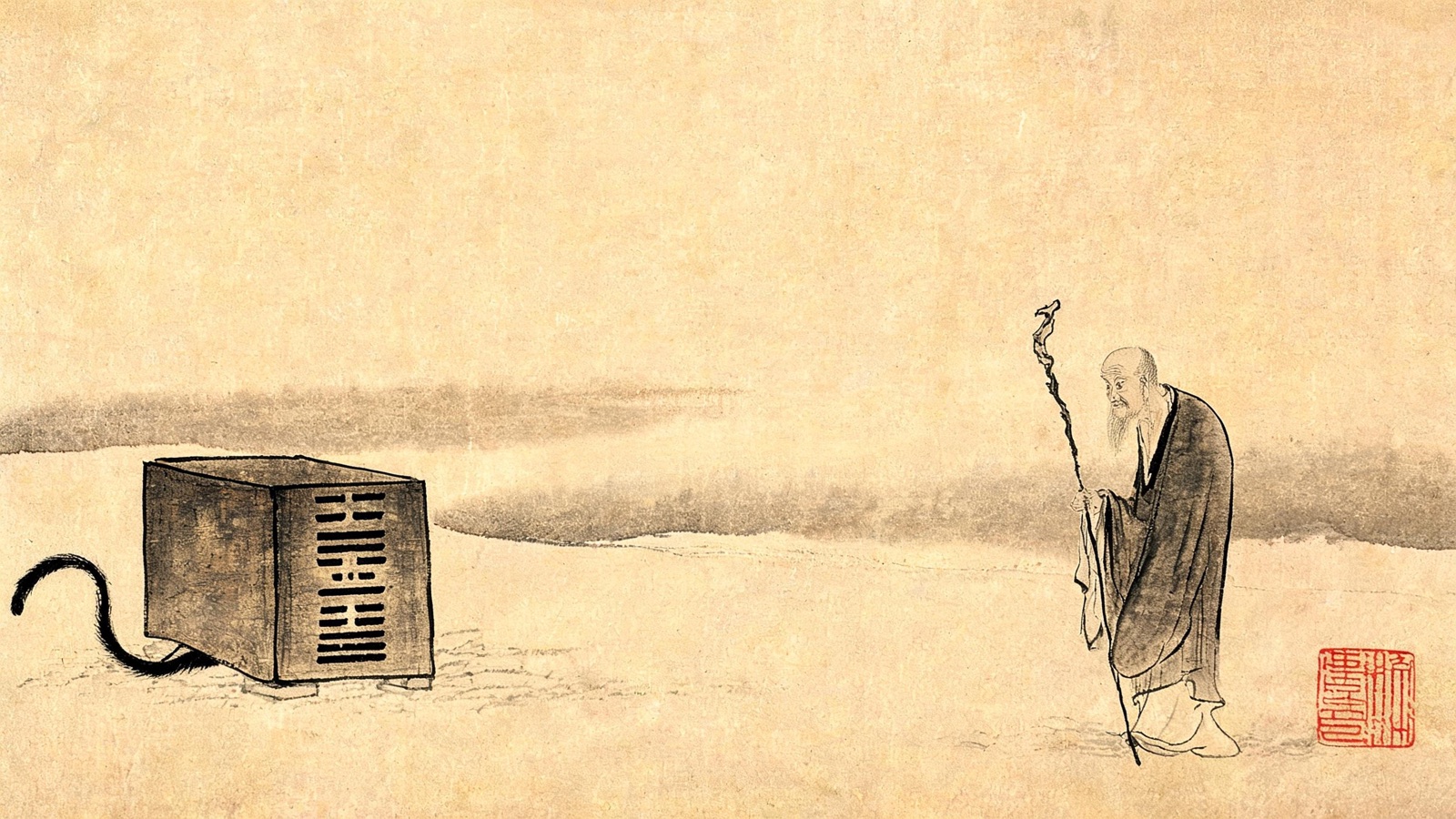
The I Ching is consulted by throwing something and reading how it lands — yarrow stalks, or three coins, six times. The throwing is the point. Nobody decides the answer.
So building it as a web app puts a question in front of you straight away. The obvious move is Math.random(), which is a deterministic function with a seed: unpredictable to you, but not undetermined. We wanted to know whether nature could pull the straws instead of an algorithm. And we wanted to play with a quantum computer.
Two problems followed. Whether the qubits could flip the coins. And how to build a machine around a book we did not write, without cheapening it.
Problem 1 — Can qubits flip the coins?
Method. A qubit put into superposition and then measured gives a bit that did not exist until measurement. Three of those is a throw of three coins. Six throws is a reading. Each tap in the app sends its own job to an IBM processor and waits for the answer. No fallback to a software random generator: if the hardware cannot answer, the app says so.
Result. Yes. A line comes back in about eight seconds when the machine is free, costing roughly two seconds of processor time.
Problem 2 — How to deliver an I Ching experience that respects the weight of this ancient book
Three thousand years old, and it does not need our help. Our job was to get out of its way — to keep it independent of us, rather than turn it into content.
Creating the right atmosphere
No frills, no flair, nothing competing for attention. There is very little on screen at any point.
The background is the exception, and it is not decoration: a live field driven by real signals, local and universal — sun elevation, moon phase, sidereal time, local weather — mapped onto the elements the book is built from: heaven, earth, water, fire, thunder, wind, mountain, lake. It ties the interface to the actual moment the reader is sitting in, rather than to a loop rendered months ago.
Respecting the act of invoking the I Ching
The app asks for something before it will answer. Ten minutes holding the question, sand running, no way to skip. One reading a week.
Both come from the book rather than from us — the fourth hexagram says the first asking informs, and asking again is intrusion, and intrusion gets no answer. The wait is there to bring some mindfulness and purpose to the act. You earn the reading, and there are no re-rolls.
Faithful to the words
- Use the original where copyright allows. All sixty-four hexagrams translated from the Chinese and the public-domain Legge (1882).
- Keep the strangeness. Treading on a tiger's tail, a well nobody drinks from, dragons. The images stay concrete and unexplained. Where the source is ambiguous, it stays ambiguous.
- Modernise the language, don't add colour. Plain modern English, no Victorian clutter — but no interpretation smuggled in either. The line says what happens; it does not say what it means for you.
- An assistant that grounds without steering. After the reading you can open a conversation with a language model to help with the language and the imagery. It is capped at five turns, it is the only generated thing on the page, and it is briefed not to tell you what the figure means or what to do. That brief took the most work: the failure mode wasn't fortune-telling, it was arriving at the same advice across unrelated readings — the model's own habits in the oracle's robe. We picked the model by giving four of them the same reading and the same five turns and reading the transcripts blind; the one that sounded least like a briefing note won, and it happens to be open-weight and among the cheapest.
Conclusion
Whether it works is for a reader to say, and only a certain kind of reader will have the patience for it.
We are glad the coins are flipped by qubits rather than by a function, and glad the thing around them asks for a bit of time and attention before it will say anything. It feels like an I Ching experience that respects what it is built on, for whoever has the inclination to meet it on those terms.
The jury is out on the assistant. Is it briefed well? What is its ideal role? Some readers just want answers and predictions — that is a responsibility it cannot take. But misguiding indirectly is equally dangerous.
Twenty minutes, and come when you won't be interrupted.
Alt-I-Ching runs at iching.altshiftlab.com. Casts run on IBM Quantum hardware. The text is our own English rendering of the Zhouyi, after Legge (1882, public domain).